
NDA 2026 Preparation Strategy – Key Insights
The NDA 2026 exam, conducted by UPSC, offers a pathway to join the National Defence Academy for aspiring defence officers. Research suggests that a structured preparation plan, starting early, can improve performance in the written exam and SSB interview, though success depends on individual effort and adherence to official guidelines. It seems likely that focusing on official syllabus topics, regular practice, and physical fitness will enhance readiness, but outcomes vary based on competition and personal aptitude.
Essential Preparation Tips
- Understand the Exam Structure: The written exam includes Mathematics (300 marks) and General Ability Test (GAT, 600 marks), with a total of 900 marks. SSB adds another 900 marks, emphasizing a balanced approach.
- Eligibility Check: Ensure you meet age limits (born between July 1, 2007, and July 1, 2010), educational qualifications (12th pass or appearing, with PCM for Air Force/Navy), and physical standards.
- Study Plan: Begin with basics in Mathematics and GAT subjects like English, Physics, Chemistry, History, Geography, and Current Affairs. Incorporate mock tests and previous year questions.
- Physical and SSB Focus: Maintain fitness through regular exercise; prepare for SSB stages including OIR tests, group tasks, and interviews.
- Common Pitfalls: Avoid ignoring negative marking (1/3 deduction per wrong answer) or skipping revisions.

NDA 2026 Preparation Strategy – Complete Guide for Aspirants
The National Defence Academy (NDA) exam, conducted by the Union Public Service Commission (UPSC), serves as the gateway for young aspirants aiming to join the Indian Armed Forces. This prestigious examination opens doors to training at the NDA in Khadakwasla, Pune, leading to commissions in the Army, Navy, or Air Force. Given the rigorous selection process, an effective NDA 2026 preparation strategy is essential for success. Starting preparation early can help build a strong foundation, especially since the NDA exam is held twice a year—NDA I and NDA II. The process involves a written examination followed by the Services Selection Board (SSB) interview and medical examination, testing both intellectual and personality traits.
Official NDA 2026 Exam Overview
The NDA 2026 exam is overseen by UPSC, ensuring a transparent and merit-based selection. The selection comprises three main stages: the written exam, SSB interview, and medical examination.
The written exam consists of two papers: Mathematics (Code 01) worth 300 marks and General Ability Test (GAT, Code 02) worth 600 marks, totaling 900 marks. Each paper lasts 2½ hours. The SSB interview carries an additional 900 marks, making the overall process highly competitive.
A key feature is the negative marking system: one-third (0.33) of the marks allotted to a question are deducted for each wrong answer. If multiple answers are marked for a single question, it is treated as wrong. Unanswered questions incur no penalty. All questions are objective-type, and the papers (except the English part of GAT) are bilingual in Hindi and English.
NDA 2026 Eligibility Criteria (As per Official UPSC)
Eligibility for NDA 2026 is strictly defined in the official UPSC notification to ensure candidates are suitable for defence training.
- Age Limit: Candidates must be unmarried males or females Age limits will be as per the official UPSC NDA 2026 notification. The date of birth is verified solely from the Matriculation or Secondary School Examination Certificate or an equivalent certificate.
- Educational Qualification: For the Army Wing, a 12th Class pass under the 10+2 pattern or equivalent is required. For Air Force and Naval Wings of NDA, as well as the 10+2 Cadet Entry Scheme at the Indian Naval Academy, candidates need a 12th Class pass with Physics, Chemistry, and Mathematics or an equivalent. Those appearing in the 12th Class can apply provisionally but must submit proof of passing by December 10, 2026.
- Physical Standards: Candidates must be physically fit as per the standards in the official notification. Minimum acceptable height is 157 cm for males (with relaxations for certain regions like Lakshadweep at 155 cm) and 152 cm for females (relaxations to 147 cm for specified regions). Weight must correspond to height as per official charts. Vision standards include corrected vision of 6/6, with limits on myopia (-1.0 D) and hypermetropia (+2.0 D). No diseases or disabilities that could interfere with efficient performance are permitted.
- Nationality: Candidates must be citizens of India, subjects of Nepal, or persons of Indian origin who have migrated from specified countries (like Pakistan or Sri Lanka) with the intention of permanent settlement. A certificate of eligibility from the Government of India is required for non-citizens, except Gorkha subjects of Nepal.
NDA 2026 Syllabus Breakdown (Official Topics)
The NDA 2026 syllabus is outlined in the official UPSC notification, focusing on Class 12-level topics to assess foundational knowledge.
- Mathematics Syllabus Overview: Covers Algebra (concepts of sets, complex numbers, quadratic equations, permutations and combinations, binomial theorem, logarithms); Matrices and Determinants (operations, inverse, applications); Trigonometry (ratios, identities, equations, heights and distances); Analytical Geometry of Two and Three Dimensions (lines, circles, conics, planes); Differential Calculus (limits, derivatives, maxima and minima); Integral Calculus and Differential Equations (integration methods, definite integrals, order and degree of equations); Vector Algebra (addition, scalar and vector products); Statistics and Probability (classification of data, measures of central tendency, probability theorems, binomial distribution).
- GAT Syllabus:
- English: Grammar, vocabulary, comprehension, and cohesion in extended texts.
- Physics: States of matter, motion laws, gravity, work and energy, heat, sound waves, light reflection and refraction, magnetism, electricity, simple machines like pendulums and pulleys.
- Chemistry: Physical and chemical changes, elements and compounds, mixtures, chemical symbols and equations, properties of air and water, acids, bases, salts, carbon forms, fertilizers, atomic structure.
- General Science: Difference between living and non-living, cell structure, plant and animal growth, human body systems, common epidemics, food and nutrition, solar system, achievements of eminent scientists.
- History: Indian history and culture, freedom movement, Indian Constitution, Five Year Plans, Panchayati Raj, teachings of Mahatma Gandhi, world events like Renaissance and revolutions, role of India in the world, United Nations.
- Geography: Earth’s shape and movements, latitude and longitude, time zones, rocks and soils, atmosphere and oceans, weather and climate, major natural regions, India’s physical features, mineral and power resources, important sea ports and trade routes.
- Current Affairs: Knowledge of important recent events in India and the world, prominent personalities in culture and sports.
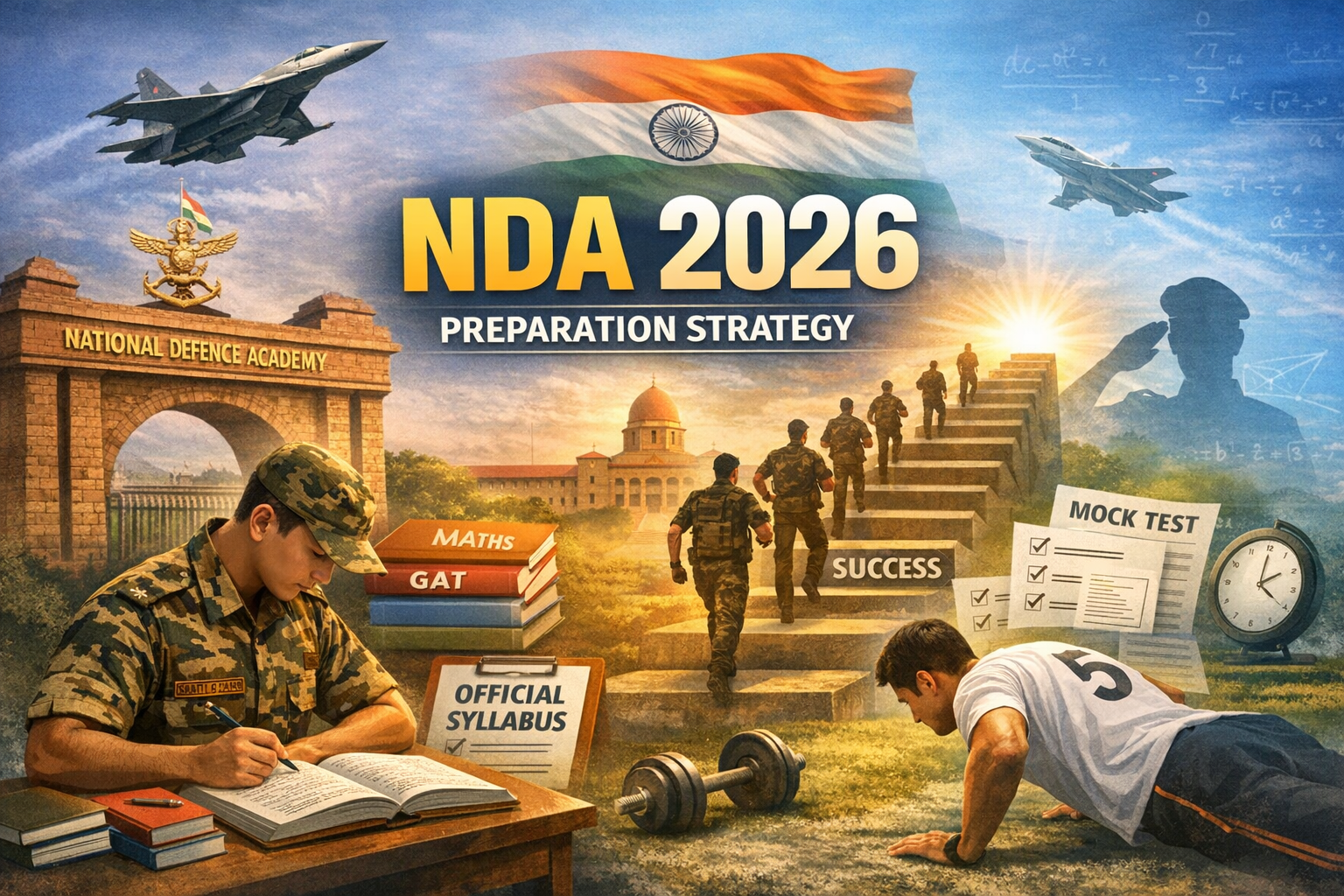
NDA 2026 Preparation Strategy (Core Section)
Developing a robust NDA 2026 exam preparation plan involves systematic study aligned with the official syllabus. Here’s a comprehensive NDA 2026 study plan to guide aspirants.
12-Month Study Roadmap
Begin with foundational building. Months 1-3: Focus on basics in Mathematics and English from GAT. Dedicate time to Physics and Chemistry. Months 4-6: Cover History, Geography, and General Science. Incorporate daily current affairs reading. Months 7-9: Intensive practice with previous year questions (PYQs) officially available on UPSC site. Months 10-12: Full-length mock tests twice a week, revision of weak areas, and initial SSB preparation.
6-Month Crash Strategy
For those starting later, prioritize high-weightage topics. Weeks 1-8: Complete Mathematics syllabus and GAT English/Physics/Chemistry. Weeks 9-16: Tackle History/Geography/Current Affairs/General Science. Weeks 17-24: Daily mocks, analyze errors considering negative marking, and build physical stamina.
3-Month Revision Plan
Focus on consolidation. Week 1-4: Revise Mathematics formulas and GAT concepts. Week 5-8: Practice section-wise tests. Week 9-12: Simulate exam conditions with timed papers, review PYQs, and refine time management.
Time Management Strategy
Allocate daily study hours: 2-3 for Mathematics, 2 for English, 1-2 each for Physics/Chemistry/General Science, and 1 for History/Geography/Current Affairs. Use timers during practice to handle the 2.5-hour paper duration effectively.
Subject-Wise Preparation Tips
- Mathematics: Practice problem-solving daily, focus on algebra and calculus.
- English: Improve vocabulary and grammar through reading.
- Physics/Chemistry: Understand concepts, solve numericals.
- General Science/History/Geography: Memorize facts, use maps for geography.
- Current Affairs: Follow reliable sources for recent events.
Mock Test Importance
Regular mocks help simulate exam pressure and identify gaps. Analyze performance to avoid negative marking pitfalls.
PYQ Importance (Officially Available Papers)
Solving official PYQs builds familiarity with question patterns.
Physical Fitness Preparation Basics
Maintain daily exercise routines like running, push-ups, and sit-ups to meet official physical standards.
NDA SSB Preparation Strategy
SSB involves Stage I (Officer Intelligence Rating tests and Picture Perception & Description Test) and Stage II (Interview, Group Testing Officer tasks, Psychology Tests, Conference). Prepare by practicing group discussions, obstacle courses, and self-introspection.
NDA Preparation After 10th
For NDA preparation after 10th, adopt a foundation approach. Build basics in Mathematics and English through school curriculum alignment. Start early physical fitness with sports and exercises. Consider NDA foundation courses in Dehradun for structured guidance.
NDA Preparation After 12th
Post-12th, shift to NDA preparation after 12th with focused revision. Engage in intensive mock practice and PYQ analysis. Groom for SSB through personality development sessions. Explore best NDA coaching in Dehradun for targeted support.
Common Mistakes to Avoid
- Ignoring negative marking, leading to score deductions.
- Skipping regular revision, causing knowledge gaps.
- Not practicing OMR sheet filling speed, risking time loss.
- Ignoring SSB preparation, as it equals written exam marks in weightage.

Ground Zero Institute – A Leading Defence Academy in Dehradun
For aspirants seeking structured support, Ground Zero Institute stands as a prominent defence academy in Dehradun with over 25 years of legacy since its establishment in 2000. The academy offers comprehensive NDA preparation programs, including written exam coaching, SSB training, and physical fitness regimens. Its mentorship-driven approach, led by experienced veterans, focuses on building officer-like qualities. Programs like the NDA foundation course in Dehradun cater to early starters, while regular NDA coaching in Dehradun helps refine skills for the exam. As one of the recognized options for best NDA coaching in Dehradun, it provides a residential setup with school integration, aiding holistic development.
FAQ Section
How to Prepare for NDA 2026?
Follow a structured NDA 2026 study plan with daily subject-wise study, mocks, and physical training, aligned to official syllabus.
What Is the NDA 2026 Syllabus?
It includes Mathematics (algebra, trigonometry, calculus) and GAT (English, Physics, Chemistry, General Science, History, Geography, Current Affairs) as per UPSC.
Is Coaching Necessary for NDA 2026?
While self-study is possible, coaching can provide guidance, especially for NDA SSB preparation strategy and mock practice.
How Many Hours Should I Study for NDA 2026?
Aim for 6-8 hours daily in your NDA 2026 exam preparation, balancing subjects and revision.